For clubs in the NSW Historic Vehicle Scheme

The register, the minutes and the declarations

In most clubs those three live in a spreadsheet, a Word file and a filing cabinet — and the one time it matters is the one time somebody checks. CarClubSoftware holds them in one place, and knows what a historic vehicle declaration actually requires before it will produce one.

Built for clubs in the NSW Historic Vehicle Scheme. Transport for NSW recognises the club, not the software — this helps a club meet its obligations; it cannot make a club eligible.

What a declaration needs

Every link in the chain, or it refuses

01The member is financial on the day — checked against the ledger, not a flag somebody set
02The vehicle is eligible and its inspection is on the record
03The club is recognised, and was recognised on that date
04The supporting events were properly minuted
05The Responsible Person is a current office holder authorised to sign
06The form prints pre-filled, for wet signature and the club stamp
The problem

Three records that disagree

A club secretary is carrying statutory obligations with office software. The register of members is a spreadsheet one person maintains. The minutes are documents in a folder. The declarations are paper. Nothing cross-checks anything, so a member who lapsed in March can still appear on a declaration signed in June — and the club only finds out when somebody asks.

Generic membership software does not fix this, because it does not know what a declaration requires. It will happily record a member, a vehicle and a date that should never have gone together.

What changes

The constitution is enforced, not described

The clause tests live in one place and the software refuses rather than warns. An unfinancial member's car cannot be declared. An event that was not properly minuted cannot support a declaration. A club that is not yet recognised cannot sign one at all.

Every change is audited — who, when, from where, with before and after — and nothing is deleted. A withdrawn declaration stays on the record showing that it was withdrawn.

What it does

A club's whole administration

One system for the committee, the members and the paperwork — each part reading the same records, so the member's screen, the treasurer's screen and the arrears sweep cannot disagree with one another.

01

Register of members

The statutory register — searchable, filterable, with history, and exportable to CSV and PDF. Members keep their own details correct instead of emailing the secretary. Offices and office holders carry effective dates, which feeds the list of club officials a scheme application asks for and decides who may do what.

02

Declarations

Eligibility, inspection records, the Responsible Person's authorisation, and a pre-filled declaration ready for wet signature and the club stamp. The member applies and can see what stage it is at and what the club is waiting on. Records are kept for the statutory period.

03

Events, minutes and attendance

Meetings and minutes, a day book, a calendar, RSVPs with guests and attendance history — including the minuted-event evidence a new club has to show. Members see what is on; the committee sees who came.

04

Money that stays true

Fee schedules are set from a date, so changing this year's subscription does not re-price last year's invoices. Pro-rata first years, a joining fee charged once, and a subscription ledger behind every figure. Waiving a subscription is recorded as a payment with a reason, not an override — so a waived member is genuinely paid up.

05

The club's own front door

A public page on the club's own domain — its name, mark, colours and every word set by the club, not by a developer. Members sign in at the same address. The registration number and the subscription are drawn from the club's record, so the page cannot drift from what the club actually charges.

06

Looked after

A nightly sweep for arrears, reminders and renewals, with a record of each run so a sweep that silently stops is noticed. Backups of the whole register — every table, every stored file, and a plain CSV a person can read — verified against checksums. Two-factor sign-in for office holders.
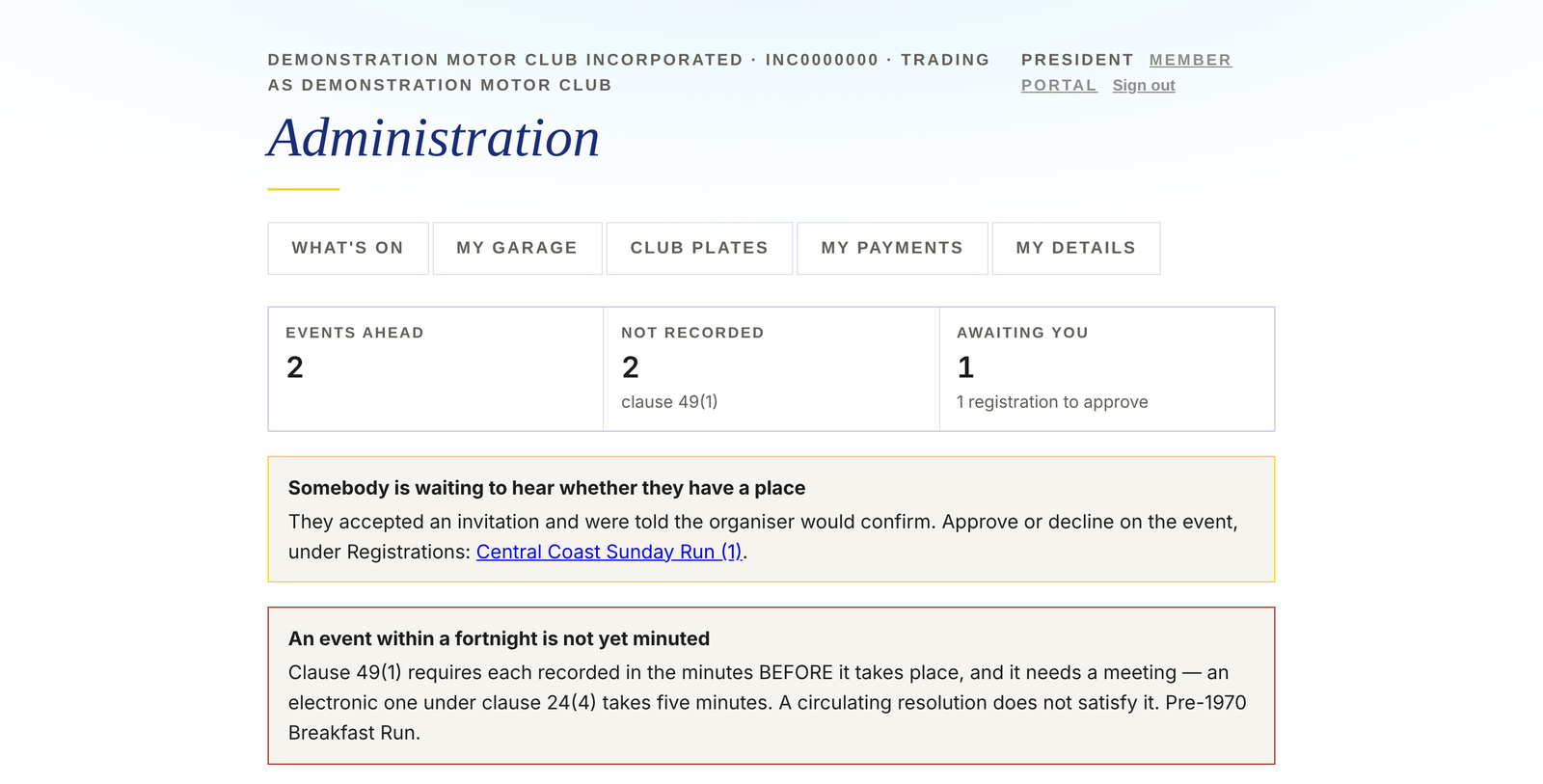
The committee's home screen, warning that an event within a fortnight has not yet been minuted, citing clause 49(1)
What the committee sees first Not a chart of how busy the club is — a list of what the constitution requires and has not had. Here an event is a fortnight away and has not been minuted, and the notice says which clause asks for it and that a circulating resolution will not do.
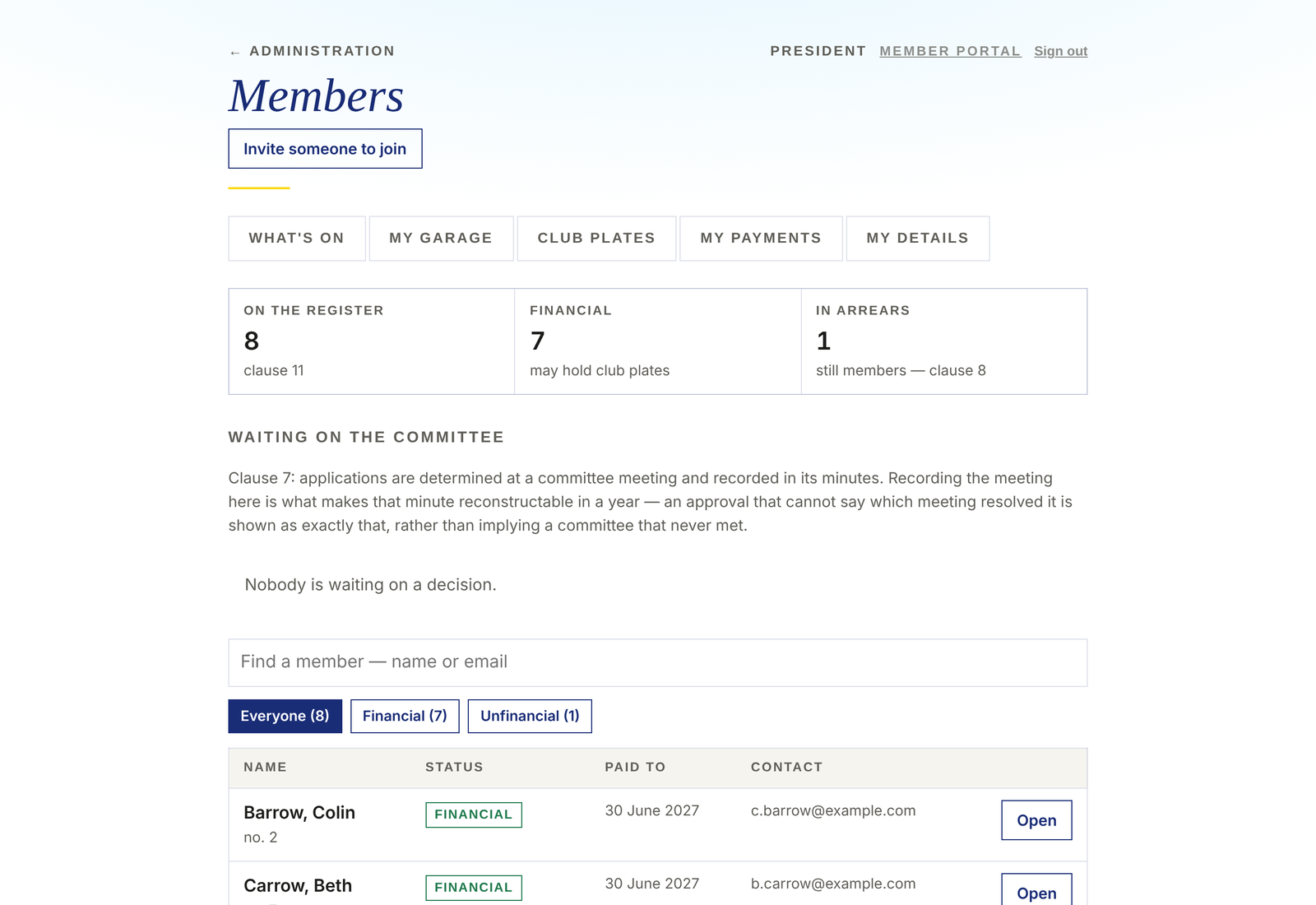
The register of members, showing counts of members on the register, financial members and members in arrears, each citing its clause
The register of members The statutory register, with the counts that actually matter beside it: who may hold club plates, and who is in arrears but — clause 8 — still a member. Exportable to CSV and PDF for the records a club has to be able to produce.

Real screens, with demonstration data. The club and the people shown are invented; no club's register appears here.

Live now

Running a real club, not a demo

CarClubSoftware is in production at a NSW incorporated association with a real register, real members and real money. A second club runs on the staging environment, so multi-club operation is exercised rather than theoretical.

Club #1 is the maintainer's own club, which is said plainly rather than dressed up as a case study — and it is why the obligations are modelled the way they are. The software was written by somebody doing the secretary's job, for the parts of it that were going wrong.

In production
ClubPetrol Power Incorporated
trading as Car Culture
RegistrationNSW INC2601167
SchemeNSW Historic Vehicle Scheme
HostingSydney region — an incorporated association's register of members stays in Australia
VendorEnovatus Pty Ltd
Where it's up to

What it does not do yet

A careful secretary is going to find these out anyway, so they belong on the page rather than in a meeting three weeks in.

Clubs cannot sign themselves up

There is no self-service onboarding. A club is set up by hand, which also means the first conversation is with a person who knows the scheme.

There is no card payment yet

Members pay by bank transfer and the treasurer records it against the ledger. Card payment is designed and not built.

It is NSW-only in practice

The scheme rules are held as data rather than written into the code, so another state is a seeding job rather than a rewrite — but no other state has been seeded, and the constitutional citations are NSW-specific.

It does not file anything

The declaration form is original-only: it must be signed by hand and stamped. The software prepares, proves and archives. A person still signs.

It confers nothing

Transport for NSW recognises the club, not the software. This helps a club meet its obligations; it cannot make a club eligible, and nothing here should be read as scheme approval of the product.

It has one maintainer

A club putting its statutory register on software with one maintainer is carrying a risk, and should know that before it decides rather than after. Full exports and verified backups exist partly for this reason.

Next

Talk to the person who built it

There is no sign-up form here on purpose. A club's register of members is not something to hand over through a checkout, and the terms that ought to govern holding it are being written properly rather than quickly. If your club runs the scheme, or is applying to, get in touch and we can look at whether this fits.

Enquire about CarClubSoftware